Transmission Resumed — A Year Inside Cursor

STATUS: SIGNAL REACQUIRED · HOMOL WORKS ONLINE · OPERATOR: MIKE HOMOL
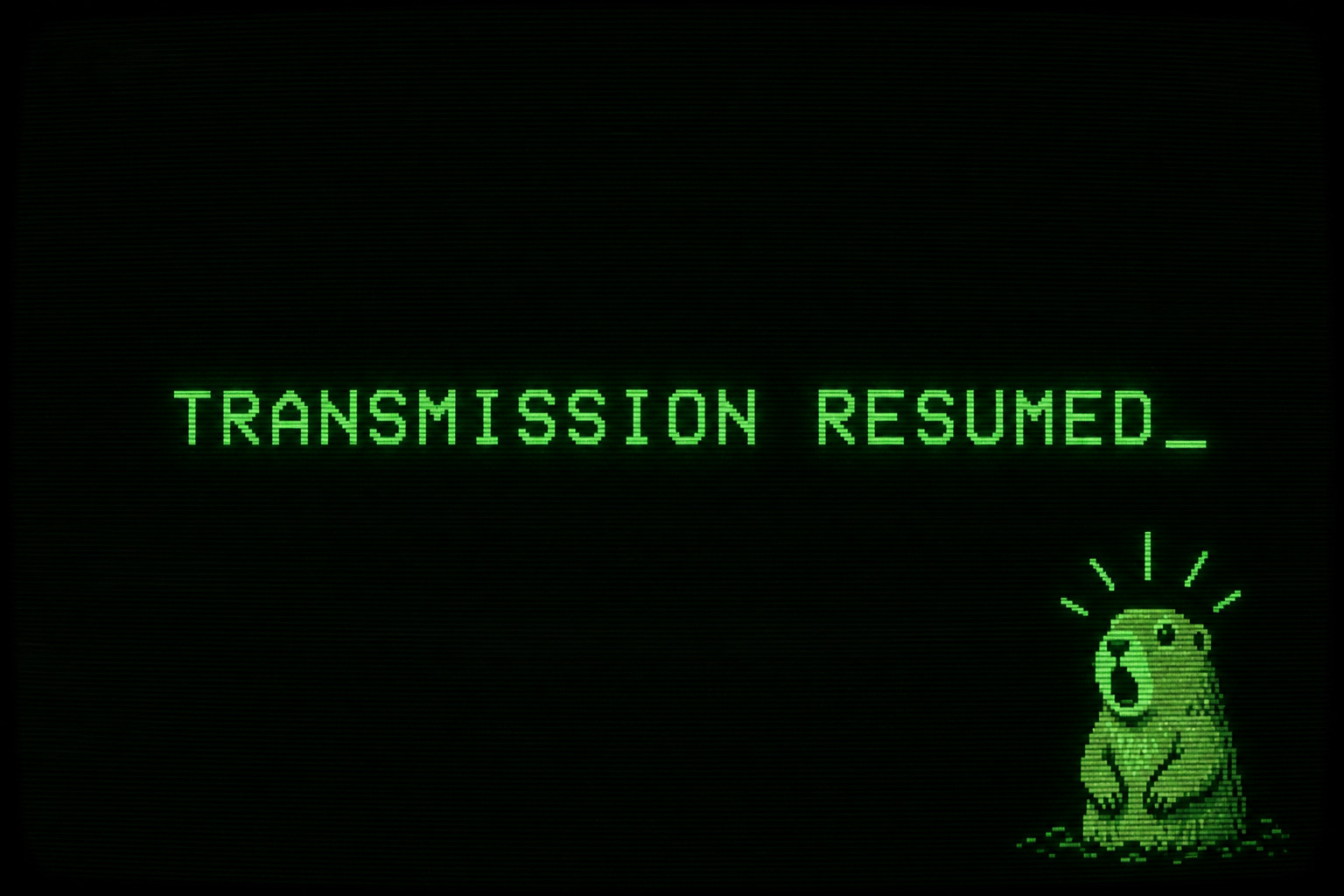
If you have been here before, the gap is obvious.
My last post on this site was Consult the Oracle in early 2023 — me staring at ChatGPT like it was the promised evolution of artificial intelligence, already wondering what it would do to coding, writing, and the shape of "thinking jobs." Then life got loud, client work stayed loud, and Homol Works went quiet.
The builder did not stop. The blog just did.
This is the transmission coming back online — and the honest recap of what the past year has looked like once Cursor became less of a novelty and more of how I actually work.
The gap was not idle time
Back in 2020 I wrote New Space, Who Dis? about finally making a site that felt like me — JAMStack, Markdown, React, room for automations, a place to combine work posts and nerd-family posts without pretending they were separate lives.
That vision still holds. What changed is how I build and how fast curiosity can turn into something shippable.
After the ChatGPT post, I kept experimenting in the browser: scaffold this, explain that, draft a script, sanity-check an approach. Useful — but always one tab away from the repo, the client tenant, the SPFx build, the Power Platform solution, the thing that actually needed to ship.
Cursor closed that gap.
Not because it replaced judgment. Because it sat inside the work — files open, diffs visible, terminal right there, context already loaded — and turned "let me go ask the oracle" into "let me pair with something that can read the codebase and help me move."
That shift is the story of my past year with AI. ChatGPT opened the door. Cursor walked through it with me.
What the past year in Cursor actually looked like
I am not going to pretend I have perfect telemetry on every session. What I do have is the trail: repos, plans, agent transcripts, and the muscle memory of showing up daily as a Principal Consultant at ThreeWill while also building personal experiments on the side.
When I recently ran a cross-workspace scan of my local Cursor history, the numbers were humbling in the best way:
- 25 workspaces — client delivery, internal products, team tooling, personal projects
- 85 agent conversations — not counting the sub-agents and the threads that spun up mid-fix
- Plans and work traces stretching back to late 2025, with the heaviest concentration in the first half of 2026
That matches how it felt: once the IDE became the cockpit, the work accelerated and diversified at the same time.
Here is the arc, by theme rather than chronology.
1. Client delivery — still Microsoft 365 at the core
Most of my professional time still lives in the world I have always loved: SharePoint, Teams, Power Platform, Azure, Copilot extensibility.
In Cursor that showed up as:
- SharePoint Framework work on reusable internal shelf solutions — compliance dashboards, referrals tooling, personnel evaluation flows, advanced page properties, and more
- Power Platform / Dataverse delivery — plugins, lead processing, recruitment workflows, prompt-to-JSON parsing fixes, the unglamorous glue that makes business apps trustworthy
- Knowledge base and Copilot enablement — search relevance, RAG architecture diagrams, client-facing "how do we manage modern SharePoint content?" enablement
- Integration spelunking — when a connection to an external system misbehaves, having an agent that can read the web part, trace the API, and propose a fix beats bouncing between five browser tabs
The pattern across client work is consistent: curiosity first, then a tight loop of inspect → hypothesize → change → verify. Cursor did not invent that loop for me. It just removed enough friction that I stay in the loop longer. Customer names and tenant specifics stay off this blog; the patterns are what travel.
2. Managed Services — the system AI did not build (at first)
Not everything in this story started inside Cursor. Some of the most important work predates the agent cockpit — and still anchors everything that came after.
Over the past few years, ThreeWill pivoted significantly down-market: more customers, served through a monthly managed services engagement rather than large one-off projects alone. Consultants — we now call them CSMs (Client Success Managers) — carry more accounts and less time per week per client. Spread thinner, with more "things" in motion, the firm needed a system that made that workload visible, manageable, and honest about whether we were winning or losing.
I architected and built that system: the Managed Services Dashboard — a full Power Platform and Dataverse solution delivered as a model-driven app with custom pages. Engagement tracking, work visualization, reporting you can stand behind. This was classic problem-solving and platform engineering; AI was not the lead actor early on. It did not need to be. The problem was structural.
Around the same pivot, we chose to specialize by vertical, starting with Human Services (often called Home and Community-based Services). That changed what "managed services" had to mean operationally. We were not only tracking hours and tasks — we were tracking reusable services and software we could carry client-to-client within a vertical, the pieces that save time or pain when the next customer has the same class of problem.
We call that reuse layer The Shelf.
The Shelf became a critical feature inside the Managed Services Dashboard: what we have already built, what is ready to adapt, what belongs to which vertical, and how it compounds delivery instead of reinventing it every engagement. Human Services shelf items have flourished especially in the past year — accelerated, honestly, once AI entered the build loop for documentation, SPFx work, and demo tooling.
That led to another spearheaded effort: a demo SharePoint intranet dedicated to the Human Services vertical — a showcase for the many ways we can assist organizations in that space, with real shelf artifacts behind the glass instead of slide-deck promises.
When I talk about Cursor and agents today at ThreeWill, ThreeWilly and ThreeSight sit on top of this foundation. The dashboard and The Shelf are the operational truth; the agents help CSMs and builders navigate it faster. AI amplified the last mile. The architecture came from years of watching how services firms actually break when they scale.
3. ThreeWill internal — turning agents into team infrastructure
Some of the most interesting recent work happened inside the firm — not only shipping features, but asking: how should our team work when AI is always available?
That led to threads like:
- ThreeWilly — an ops workspace where Cursor helps with Managed Services context, scorecards, CSM drafts, Ruddr time, and the weekly "what actually happened?" questions that are easy to defer and expensive to forget
- ThreeSight — revisiting a Copilot Studio agent I built long ago and revitalizing it with layered instructions, Dataverse business skills, and MCP-discoverable capabilities so it behaves like a read-only intelligence assistant instead of a dusty demo
- Engineering standards and "non-negotiables" — a living taxonomy of things we expect on every solution, encoded so agents can help enforce them instead of leaving quality entirely to memory and luck
- Ruddr MCP — pushing our PSA integration further so capacity, projects, and time are queryable from the same environment where we already write code and docs
This is where my relationship with AI stopped feeling like "cool pair programmer" and started feeling intertwined with how a consulting team operates.
4. MCP — the wiring diagram behind the magic
If Cursor is the cockpit, MCP servers are the instruments on the panel.
Over this stretch I leaned heavily into connecting agents to real systems:
- Microsoft 365 — mail, calendar, Teams, SharePoint, OneDrive, Word (with the usual enterprise consent realities)
- Dataverse — especially Managed Services operational data
- Ruddr — project/time context for consulting workflows
- Microsoft Learn docs — grounding answers in current official guidance instead of vibes
The lesson was not "connect everything." The lesson was connect the right things with guardrails — read-only where possible, explicit skills for dangerous operations, and enough documentation that future-me (or future-teammate) knows why a tool exists.
Yes, I also had the universal MCP experience of everything catching fire until a full Cursor restart cleared it. File->Quit remains undefeated.
5. Personal builds — curiosity on my own terms
Not everything was billable. Some of the most energizing Cursor time went to Homol-Works side quests:
- 90-Day / Memento Mori — a long-running personal app thread where I chased iOS widgets, Expo SDK upgrades, TestFlight failures, and the eternal question: "are we close enough to keep going or should we park this?"
- Homol-Rides / Backseat Games — a family road-trip game idea that became Backseat Games on the App Store — built with Cursor to turn phones into shared play instead of solo scrolling
- Homol-Invests — early exploration of an AI-assisted investing experiment (more curiosity lab than product — for now)
- Workspace activity reporting — meta, but on-brand: a skill that scans agent transcripts across projects and renders a report card so I can see what is in flight, what needs a commit, and what conversation I should return to
These projects matter to the story because they are pure problem-solving energy — the same trait that pulled me toward Microsoft 365 a decade ago, now pulling me toward agents, mobile widgets, and weird little games for my kids in the back seat.
6. Homol Works itself — the site as proof of the workflow
Which brings us to why you are reading this on a terminal-green page with a surprised gopher in the navbar.
Homol Works was a five-year-old Docusaurus experiment — alpha-era dependencies, homepage widgets calling old Azure Functions, last meaningful blog activity years ago. Classic "personal brand hostage to busy season" stuff.
This week, with Cursor as the primary builder, the site got:
- A Docusaurus 3 upgrade path and a modern React baseline
- A WarGames-inspired terminal hero — blinking cursor,
help, easter eggs, randomized taglines - A surprised gopher logo — extracted from the hero art, because some brand decisions are non-negotiable
- Static Microsoft Learn achievements instead of fragile live API calls (130 badges and 39 trophies at last refresh — because Microsoft does not hand you a simple personal badges API and I am not pretending otherwise)
- A weekly accomplishments draft pipeline — automation that writes reviewable raw material under
blog-unpublished/instead of auto-publishing my half-formed thoughts to the open internet - An honest AI disclosure — this site is maintained as a collaboration between Mike Homol and Cursor; I think that is a feature, not a footnote to hide
In other words: the comeback post and the comeback site are the same thesis. Use AI to reduce friction on the work you already care about. Keep judgment. Publish deliberately.
What I believe now (that I only suspected in 2023)
When I wrote about ChatGPT as the Oracle, I was excited and a little unnerved — productivity upside on one hand, "what happens to thinking jobs?" on the other. I still hold both truths.
What a year inside Cursor taught me is narrower and more useful:
- Curiosity scales when the ask-build-learn loop gets shorter. I always loved solving problems. AI did not replace that love. It fed it.
- The highest leverage is not codegen. It is context: skills, rules, MCP, repo structure, and workflows that teach the agent how we work.
- Client-safe delivery and personal experimentation are not opposites. The same habits — small diffs, verify claims, describe client work generically on the blog — apply everywhere.
- Learning in public requires a review gate. Weekly drafts, unpublished folders, and human approval on AI-generated media beat hot takes every time.
- The blog matters again. Not because the industry needs another AI post. Because writing is still how I compress experience into something future-me can reuse.
This is a series, not a single dump
This post is intentionally broad — the "transmission resumed" beacon. Deeper installments are planned so each one stays useful instead of turning into a memoir nobody finishes.
Planned follow-ups (links will appear here as each post publishes):
- Transmission Resumed (this post) — the gap, the shift from browser AI to IDE pairing, the thematic recap
- Bringing Homol Works Back With Cursor — Docusaurus upgrade, terminal theme, Learn badges, weekly draft automation
- MCP and the Consulting Cockpit — wiring agents to M365, Dataverse, Ruddr, and docs without losing your mind
- Shelf Life — SPFx reuse, internal products, demo tooling, and what "build once, adapt often" looks like with agents in the loop
- Backseat Games Shipped — road-trip games, App Store launch, building for family play with Cursor
- Side Quests — Memento Mori and other personal projects as curiosity labs
The working outline stays in the repo under blog-unpublished/ for my own planning.
If there is a thread you want higher in the queue, tell me. The gopher listens.
What comes next on Homol Works
Short term:
- Keep running weekly AI build drafts and promote the good parts into posts
- Refresh Learn achievements on a sane cadence
- Fix the boring broken links and author metadata the build already warned about (because agents love warnings and I love quiet builds)
Long term:
- More nerdy transmissions — practical Microsoft 365 and Power Platform notes, agent workflow patterns, things I wish I had found in one place
- Less guilt about gaps between posts — the goal is signal, not schedule for schedule's sake
- A site that stays fresh because the maintenance workflow is designed for how I actually work now
Homol Works is maintained as an AI-assisted collaboration between Mike Homol and Cursor. This post was drafted the same way — reviewed and edited by a human who still owns the opinions. Hero image AI-generated, human reviewed.